How to Choose a Welding Gas Regulator in Australia Matter
Selecting the right regulator starts with choosing one that is designed for your specific gas and provides the pressure or flow needed for the job. All gas regulators sold in Australia should be designed in accordance with AS 4267, with each gas type featuring a unique cylinder connection to prevent incorrect regulator-to-cylinder fitment. This guide explains how to select the correct regulator for oxygen, acetylene, LPG, argon, and CO₂, outlines safe installation practices, and identifies when regulator replacement is required.
Selecting the right regulator starts with choosing one that is designed for your specific gas and provides the pressure or flow needed for the job. All gas regulators sold in Australia should be designed in accordance with AS 4267, with each gas type featuring a unique cylinder connection to prevent incorrect regulator-to-cylinder fitment. This guide explains how to select the correct regulator for oxygen, acetylene, LPG, argon, and CO₂, outlines safe installation practices, and identifies when regulator replacement is required.
What a Gas Regulator does
A regulator performs two critical functions. They reduce the high pressure stored in the cylinder (often up to 20,000 kPa for oxygen, argon, and other inert gases) to a safe working pressure, whilst maintaining consistent pressure as the cylinder contents are used.
They also maintain consistent outlet pressure, which distinguishes a true regulator from a simple flow restriction device. This consistency helps keep cutting flames stable and shielding gas coverage uniform, from a full cylinder through to near empty.
Gas Regulator Selection Table
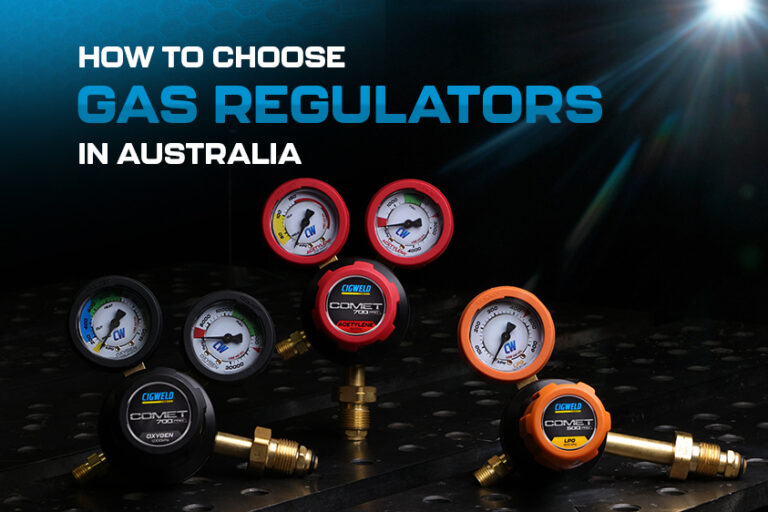
Start by identifying the gas, as each regulator is designed for a specific gas type. The table below shows the compatible applications for each COMET gas regulator. “VI” refers to a vertical inlet regulator and “SI” refers to a side inlet regulator, with the choice depending on how the regulator is mounted to the cylinder.
| Gas | Suited Application | COMET Regulator Part Number | Max outlet | Cylinder inlet |
|---|---|---|---|---|
| Oxygen | Oxy-fuel cutting, heating, brazing | COMET 700 Oxygen, VI (301637) or SI (310638); 400 kPa VI (310639) | 1,000 kPa (400 kPa on 310639) | Oxygen |
| Acetylene | Gas welding, cutting, heating | COMET 700 Acetylene, VI (301532) | 150 kPa | Type 20 |
| LPG | Oxy-LPG cutting, heating, brazing | COMET 500 LPG, SI (301525) | 400 kPa | LPG |
| Argon | MIG and TIG shielding gas | COMET 500 Argon, VI (310601); Argon Preset (310602) | 45 L/min; 200 kPa Preset | Type 10 |
| CO2 | MIG shielding gas | COMET 500 CO2, SI (310795) | 20 L/min | Type 30 |
The COMET 700 series also includes a Nitrogen (310801), Inert (310802) and Hydrogen (310803) regulator for purging and specialty work.
As a rule of thumb, the 700 PRO range suits demanding workshop and site environments, while the 500 PRO range covers everyday industrial applications.
Why Do Gas Threads and Colors Differ?
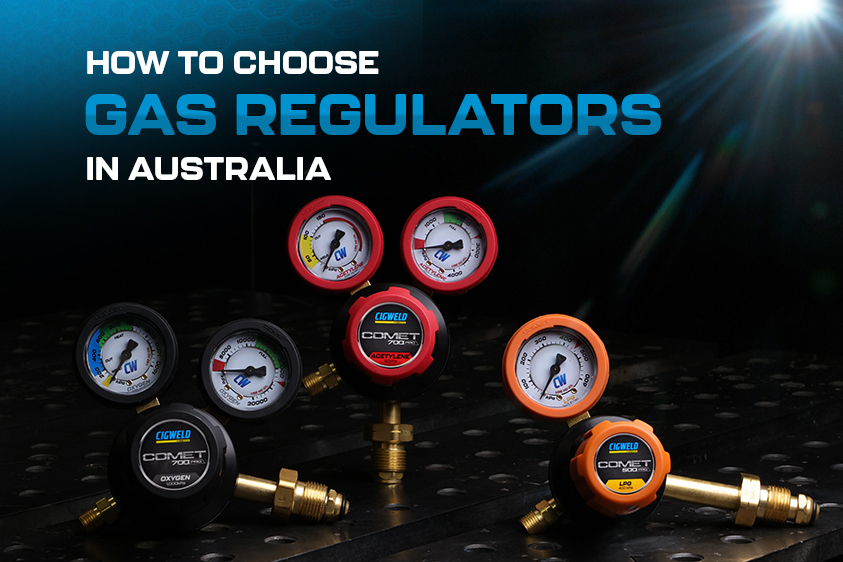
Each gas is supplied with a unique cylinder connection, ensuring that regulators can only be fitted to the gas they are designed to control. For example, acetylene and hydrogen cylinders use a left-hand (Type 20) thread, while CO₂ cylinders use a dedicated Type 30 connection. COMET regulators are also colour-coded by gas type, making it easy to identify the correct regulator.
The safety rule is straightforward: only use a regulator with the gas it is specifically designed for. If a regulator does not fit the cylinder connection, do not force it or use an adaptor. Always verify that the regulator label matches the cylinder contents before making a connection.
Pressure vs Flow: Understanding Shielding Gas Regulators
Oxygen and fuel regulators are typically adjusted by outlet pressure, measured in kPa, as torch tips and cutting nozzles are designed to operate at specific pressures. Shielding gas applications such as MIG and TIG welding work differently, as weld protection depends on gas flow rate rather than pressure. For this reason, COMET argon and CO₂ regulators are flow-rated, displaying output in litres per minute (L/min) to allow accurate flow control.
The COMET Argon Preset regulator (310602) provides a fixed outlet pressure of 200 kPa and is suited to systems where flow is controlled downstream using a separate flowmeter. For applications requiring flow adjustment directly at the cylinder, the flow-rated COMET 500 Argon regulator (310601) is the preferred option.
When using CO₂, additional safety precautions are required. As CO₂ can displace oxygen and create an asphyxiation hazard in confined spaces, regulators should only be installed and operated in well-ventilated areas. It is also important to note that the pressure relief valve fitted to a CO₂ regulator is designed to protect the regulator itself and should not be relied upon as a safety device for downstream equipment.
Common Regulator Applications in Australian Workshops
- Farm and rural maintenance. Oxy-fuel equipment is commonly used for cutting steel, heating seized components, and straightening damaged parts in locations where electrical power may not be readily available. These applications typically require an oxygen regulator matched with either an acetylene or LPG regulator.
- Fabrication and repair workshops. Cutting, heating, straightening, and gas welding operations depend on correctly matched oxygen and acetylene regulators to ensure safe and consistent performance.
- MIG and TIG welding stations. Argon and CO₂ regulators are used to control shielding gas delivery, helping maintain weld quality by providing consistent gas flow and protecting the weld pool from contamination.
- Mobile service vehicles. On-site cutting, brazing, and heating applications demand durable regulators capable of withstanding transport and harsh working conditions. COMET regulators feature rubber gauge guards to help protect gauges from accidental impacts.
When selecting a fuel gas, it is important to consider the intended application. LPG is well suited to cutting, heating, and brazing, while acetylene is required for oxy-fuel gas welding applications.
COMET Regulator Start-Up and Shutdown Procedures
This sequence follows the COMET operating manual. Read the full manual and your workplace safety procedures before you start.
- Remove the cylinder valve dust seal and crack the valve open briefly to clear dust. Point the outlet away from people and ignition sources and crack fuel gas valves only in a well-ventilated area.
- Check that the regulator label and the cylinder marking match. Tighten the inlet connection firmly with a suitable spanner, but not excessively.
- Connect the outlet hose. For oxy-fuel work, fit at least an AS 4603 flashback arrestor and non-return valve on each gas line. AS 4839 recommends fitting them at both the regulator and the torch.
- Wind the adjusting knob right out, stand to one side of the regulator and open the cylinder valve slowly. A sudden surge can damage the internal parts.
- With the downstream valves closed, turn the knob clockwise to roughly your working pressure, then check every connection for leaks with leak detection solution or soapy water. Never use a flame.
- Purge each line by opening one downstream valve at a time for several seconds (longer on long hoses), then close it before opening the next. Never purge oxidizing or flammable gases near a flame, lit cigarette or other ignition source.
- Open the torch or equipment valve and fine-tune the knob until the outlet gauge shows the pressure you need. The gauge only shows true working pressure with downstream valves open, so finish the setting with gas flowing.
When you finish, close the cylinder valve, open the downstream valves to drain the lines in a well-ventilated area away from ignition sources, then wind the adjusting knob out and close the valves again.
Three rules from the manual are worth repeating. Keep oil, grease and anything combustible away from oxygen regulators and fittings. Never use acetylene at a pressure above 150 kPa. And never use a regulator that isn’t made for oxygen in oxygen service.
If you’re starting from scratch, a kit saves you matching the parts yourself. The COMET Gas Kits pair COMET 700 regulators (plus a COMET 500 LPG regulator in the oxy-LPG kits) with a cutting torch or blowpipe set, flashback arrestors for the torch and regulator ends, fitted twin hose, nozzles or tips, goggles and a lighter, all in a hard case, and conform to AS 4839.
When to Service or Replace a Regulator
- Five-year limit. The COMET manual says regulators, flashback arrestors, blowpipes, attachments, mixers and cutting torches must be refurbished or replaced after five years of service, as noted in AS 4839-2001.
- Damage or contamination. Don’t use a regulator with broken, missing, worn, distorted or contaminated parts. Replace those parts, or the regulator, straight away.
- Flashback arrestors. Have them inspected and tested by a competent person every 12 months, and have them inspected after any flashback.
- Spare parts. Gauges, gauge guards, seat capsule assemblies, diaphragms and O-rings are listed in the COMET manual for the 700 and 500 ranges.
- Warranty. CIGWELD covers gas regulators for 5 years, with shorter periods for seat assemblies and gauges (6 months) and elastomer seals and O-rings (3 months). Check the full terms in the manual.
COMET Regulator Features
COMET regulators conform to AS 4267. Across the range, internal gas control components are protected against flashback, and the gauges are designed to fail safe so no parts are thrown if a regulator fails. The 700 series adds a fully encapsulated Tri-Port seat with an integrated sintered filter, and rubber gauge guards for impact protection. Each unit is color coded by gas and laser engraved for identification and traceability.
Backed by 100+ years of CIGWELD expertise, the full range is on the COMET regulators page.
Frequently Asked Questions
Can I use an oxygen regulator on an acetylene cylinder?
No. Each gas has its own cylinder connection, and acetylene uses a left-hand thread, so the regulator won’t fit. The COMET manual says never to connect a regulator designed for one gas to a cylinder holding any other gas, and never to use a non-oxygen regulator in oxygen service.
What pressure should I set my acetylene regulator to?
Never above 150 kPa, which is also the maximum outlet of the COMET 700 acetylene regulator. Within that limit, set the pressure to suit your torch and tip using the tip manufacturer’s chart.
Do I need flashback arrestors on my regulators?
Yes, for oxy-fuel work. The COMET manual requires at least an AS 4603 flashback arrestor and non-return valve on each gas line, and AS 4839 says that for optimum protection they should be fitted at both the regulator and the torch. Have them inspected and tested by a competent person every 12 months.
How long does a gas regulator last?
The COMET manual says regulators must be refurbished or replaced after five years of service, as noted in AS 4839-2001. Replace one sooner if it is damaged, leaking or has contaminated parts.
Can I use an argon regulator for CO2?
No. Argon and CO2 have different cylinder connections (Type 10 and Type 30), and CO2 regulators are fitted with a pressure relief valve to protect the regulator. For CO2, use the COMET 500 CO2 regulator (310795).
What is the difference between the COMET 700 and COMET 500?
Both conform to AS 4267 and protect internal gas control components against flashback. The 700 PRO is built for demanding environments and has a fully encapsulated Tri-Port seat with a sintered filter. The 500 PRO covers everyday industrial applications. The 700 range covers oxygen, acetylene, nitrogen, inert and hydrogen, while the 500 range covers argon, LPG and CO2.
This guide is general information. Always follow the operating manual for your equipment and your workplace safety procedures.