
Silicon Carbide (SiC) Inverter Welding Machines Explained: Benefits, Performance & Why They Matter
In this article
Silicon carbide has become one of the more common terms on welder spec sheets over the past few years, usually printed next to the price tag as if it settles the argument on its own. It’s a fair thing to be sceptical about. Plenty of terms get used in marketing without much behind them.
Silicon carbide isn’t one of those. It’s a genuine improvement in how an inverter welder is built, and it has a real, measurable effect on how the machine performs. It just doesn’t matter equally to everyone, and it’s worth understanding what it does before deciding whether it’s worth paying extra for.
What silicon carbide actually is
Silicon carbide is a compound of silicon and carbon, and it’s not new. It’s one of the hardest synthetic materials available and has been used in grinding wheels and sandpaper for well over a century. Anyone who’s ground back a weld with a flap disc has almost certainly handled it without realising.
What’s changed more recently is the ability to grow silicon carbide into the pure crystal form needed for semiconductors and transistors, the small components that do the actual work inside an inverter power supply. Engineers found that silicon carbide made a noticeably better semiconductor material than plain silicon, which is what nearly every inverter welder has used since inverters replaced transformer machines decades ago.
That’s the essence of it: the same job, done with a better material. The rest of this comes down to why that swap makes a practical difference.
Where it sits inside the machine
Every inverter welder works on the same basic principle. It takes AC power from the wall, converts it to DC, then switches that DC on and off tens of thousands of times a second. That switched output then passes through a transformer, which steps it down to the low-voltage/high-current power an arc actually needs, before it’s sent out to the torch. The component doing the switching is a transistor, and how fast it can switch affects more than just itself: the faster the switching frequency, the smaller and lighter the transformer can be while doing the same job. That’s part of why SiC machines can end up more compact overall, not purely because the transistor runs cooler, but because everything downstream of it can shrink too.
In a conventional inverter, that switching is done by a silicon IGBT (Insulated Gate Bipolar Transistor). In a SiC inverter, it’s done by a silicon carbide MOSFET instead. The transformer, wire feed system, control board, and torch are still built on the same principles either way, but a machine genuinely engineered around SiC will typically pair the faster switch with a smaller transformer and lighter cooling to make the most of it. The transistor is what makes the improvement possible, but it’s the rest of the design working with it that actually delivers it in practice, a point worth keeping in mind, and one this article comes back to a little further down.
SiC vs the standard silicon inverter
| Regular inverter (silicon IGBT) | SiC inverter (silicon carbide MOSFET) | |
|---|---|---|
| Switching speed | Limited by a residual current lag as the switch turns off | Faster, without that lag |
| Heat generated | Higher | Lower |
| Operating temperature | Runs hotter under sustained load | Stays cooler at the same output |
| Thermal ceiling before performance drops | Lower | Higher |
| Size and weight | Bulky, with heavy and larger heatsinks for cooling | Smaller with lighter cooling systems |
| Performance over long, high-amperage runs | Tends to fall away | Holds up more consistently |
The underlying reason is a matter of material physics rather than manufacturing preference. In a silicon IGBT, a portion of the current lingers for a fraction of a second after the switch turns off, an effect engineers call tail current, and it’s what limits how quickly a silicon IGBT can switch and wastes energy as heat on every cycle.
That raises a reasonable question: ordinary MOSFETs don’t suffer from tail current the way IGBTs do, so why didn’t welding manufacturers just use plain silicon MOSFETs from the start? The answer comes down to current handling. A plain silicon MOSFET struggles to carry the higher currents a welding inverter needs without a real efficiency penalty, so despite the tail current drawback, silicon IGBTs became the standard choice for high-power inverters simply because they could handle that current better than a silicon MOSFET could.
Silicon carbide removes that trade-off rather than shifting it somewhere else. A SiC MOSFET switches the same clean way an ordinary MOSFET does, with no tail current, while still handling the higher voltage and current a welding inverter needs, which is exactly what plain silicon MOSFETs were never quite able to do at this scale. On top of that, silicon carbide can withstand a much higher electric field in a much smaller volume than silicon, and conducts heat away considerably more effectively. The result is a switch that’s fast, clean, and cooler, without giving up any current-handling capability to get there.
What it means for the person holding the torch
For all the changes inside the machine, they’re only useful if they translate into something noticeable at the work bench; and they do!
A steadier arc is one of the more immediate differences, particularly at lower amperage. Faster switching lets the machine respond to changes in the arc almost instantly, which shows up as a cleaner, more consistent bead, especially on thinner materials where an unstable arc becomes obvious quickly.
A better duty cycle follows on from that. Because the switching component isn’t wasting as much energy as heat, the machine’s internals stay cooler for longer under load, meaning less time spent waiting for it to cool before continuing.
That same reduction in heat also means manufacturers can build smaller, lighter machines without compromising on power. A large part of the bulk in a conventional inverter exists purely to manage heat; larger heatsinks and cooling fans. Since SiC semiconductors generate less heat to begin with, that hardware can shrink without the output shrinking with it, which matters for anyone regularly moving a machine between sites.
There’s a modest efficiency saving too. Less energy lost as heat means more of the power drawn from the wall actually goes into the weld, which adds up over time for a machine used daily in a fabrication setting.
And because silicon carbide tolerates higher operating temperatures before performance starts to drop off, machines built on it are less likely to throttle back on a genuinely hot day in a shed with no airflow, a fairly common Australian summer scenario for anyone welding outside an air-conditioned workshop.
When you’ll notice it, and when you won’t
For light or occasional welding, weekend projects, small home repairs, a well-built silicon inverter will do the job perfectly well, and the difference may not be noticeable at all. Silicon carbide earns its keep in a narrower set of circumstances:
- Extended, high-output work such as structural fabrication, where a conventional inverter would ordinarily need to pause and cool.
- Precision work on thin or heat-sensitive material, including aluminium panels, sheet metal, and thin-gauge stainless, where arc stability at lower amperage has a direct effect on weld quality.
- Site work, where generator power, ambient heat, and machine reliability all carry more weight than they do in a controlled workshop environment.
The catch
Silicon carbide components remain more expensive to manufacture than plain silicon, and that cost is generally reflected in the price of the machine, though the gap has narrowed considerably as SiC production has scaled up across the industry. It’s also worth noting that the presence of silicon carbide alone doesn’t guarantee a better machine. The rest of the design needs to be built around it to realise the full benefit; simply substituting the component without adjusting the surrounding engineering delivers a smaller improvement than the specification sheet might suggest. It’s a detail worth judging machine by machine rather than assuming from the label.
Is it worth paying for?
For anyone welding professionally, running long sessions, working at higher amperage, or moving equipment between job sites regularly, the efficiency and heat advantages of silicon carbide tend to justify the additional cost fairly quickly. For lighter or occasional use, a well-constructed traditional inverter will still perform reliably, and the premium may not be necessary yet. As with most welding equipment decisions, the technology inside the machine matters less than the overall build quality and the warranty backing it.
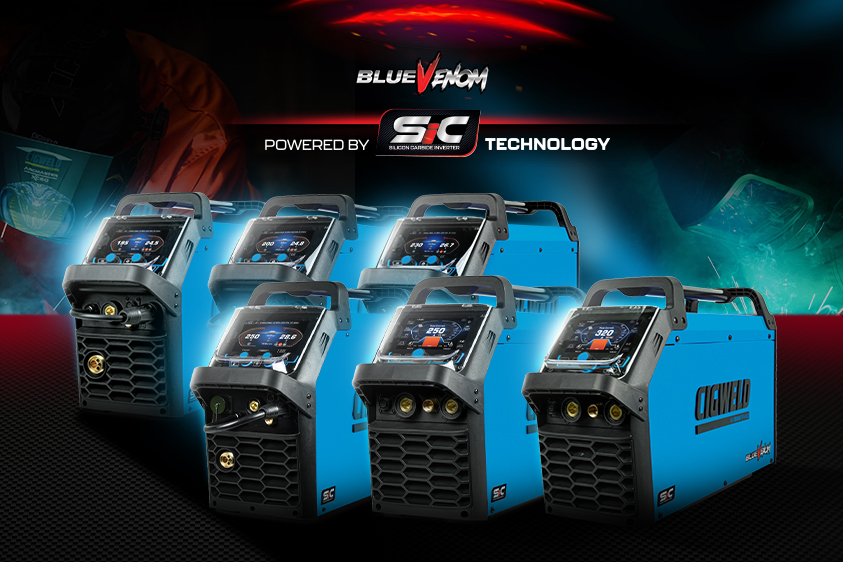
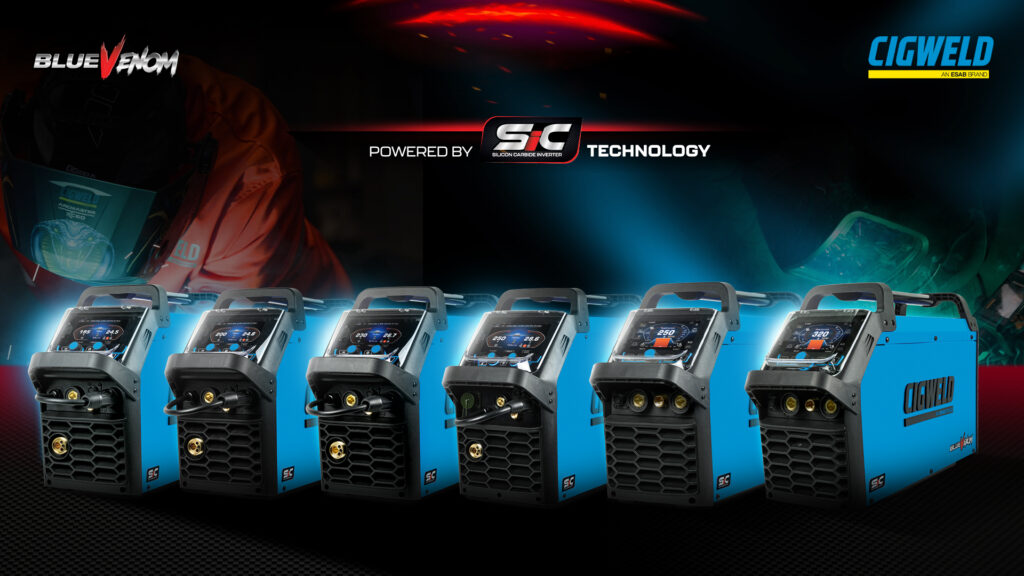
CIGWELD’s own BlueVenom SiC range is built around this exact technology, engineered specifically to take advantage of the faster switching and lower heat generation silicon carbide offers rather than simply swapping the component in. For anyone weighing up whether the step up is worth it for their own work, it’s a practical starting point to see the specs and duty cycle figures side by side against a conventional inverter.
FAQs
What does silicon carbide actually do in a welder?
It’s used to build the switching component inside the power supply, replacing the conventional silicon IGBT with a faster, cooler-running silicon carbide MOSFET. That change is what improves efficiency, arc stability, and duty cycle.
Is a silicon carbide welder genuinely better, or mostly marketing?
It’s a genuine improvement for sustained or high-output welding, delivering better efficiency, duty cycle, and arc stability. For light or occasional use, the difference compared with a good standard inverter is unlikely to be noticeable.
Why do silicon carbide welders cost more?
The components themselves are more expensive to manufacture, although prices have come down as more manufacturers adopt the technology. Over time, the cost is often offset through lower running costs, and reduced downtime.
Why is a faster switching speed better?
Faster switching lets the machine make finer, more frequent adjustments to the arc rather than broader, slower corrections, which is what produces a steadier arc and a cleaner bead. It also allows smaller transformers and other passive components to do the same job, since higher-frequency electronics can be physically smaller without losing performance, part of why faster-switching machines can end up lighter and more compact too.
Do I need a silicon carbide welder for home or hobby use?
Not generally. A solid standard inverter is well suited to occasional repairs or hobby projects. Silicon carbide becomes more relevant once welding is frequent, sustained, or done at higher amperage.
Does silicon carbide genuinely improve duty cycle?
Yes. Because it wastes significantly less energy as heat than a standard silicon IGBT, the internal components take longer to reach their thermal limit, allowing for longer welding sessions before the machine needs to cool.
Want to see one in person? Find your nearest CIGWELD stockist →